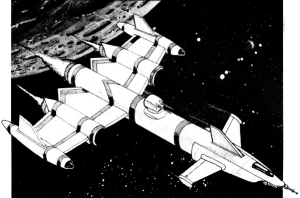
 Transport Ships
Spaceliners. HULL SIZE = 6-15. Spaceliners (passenger transports) are built in a wide variety of sizes. Modern spaceliners are fast, quiet ships, capable of providing the wealthy passenger with any conceivable luxury. Many of the older liners are smaller, somewhat decrepit vessels that promise only the fundamental requirements of life support. The number of passengers carried by a spaceliner is about 25 times the ship's hull size. For example, a spaceliner with a hull size of 10 can carry 250 passengers. Engine durability varies as much as size on spaceliners. Some will require an overhaul after three jumps, while others will be able to make 8 or 10 interstellar trips without maintenance.
Freighters. HULL SIZE = 5-20. Freighters (freight transports) are built in a greater variety of styles than spaceliners. The largest are as big as a battleship, but are much slower and less maneuverable. Some small freighters are fast enough to out-run pirate vessels or spacefleet frigates. Most of the room in a freighter is taken up by cargo, so the crew generally will approximately equal the ship's hull size. As with spaceliners, differences in engine performance allow some freighters to make many jumps without adjustment, while others must be overhauled after each trip.
East Indiaman. HULL SIZE = 10 The East Indiaman Class has a beam of 39m and an overall length (including the drives) of 210m. The ship's only defensive system, a reflective hull, is provided as standard, as is a laser battery mounted in a chin turret. East Indiamen are usually powered by three type B ion engines, these are usually de-rated military drives, or occasionally UPF surplus drives. Launched from the airdock of Tallyman Associates (the designers at Triad Starport, a basic East Indiaman as described bewlow costs Cr 1,330,000. If built by a licensed contractor at another Class I starport the cost of the basic ship rises to Cr 1,570,000.
Scientific Research Ships System Ships. HULL SIZE = 3-6. System research ships are basically self-propelled laboratories that are based at space stations or (rarely) at a spaceport on a planet. They are used to explore, map and analyze the planets, asteroids, moons and star(s) of a given star system. Detection of gravitational patterns, star mapping, and atmosphere and ecological analysis of potentially habitable planets are among the primary functions of a system research ship. The rocket engines of a system ship are not capable of interstellar travel, but a large research ship can spend up to a year in space before returning to base.
Starships. HULL SIZE = 3-7. Starship research vessels have atomic engines and are capable of interstellar jumps. These ships often are used to examine recently discovered systems, deep space phenomena (gas clouds and such) or mineral content in distant and uninhabitable planets and asteroids. Performance is not a priority on these ships, so acceleration and maneuverability tend to be poor. However, starship research vessels often are capable of making three jumps before the engine needs an overhaul.
Agriculture Ships and Stations
Agriculture Starships. HULL SIZE = 8-16. Agriculture starships are very expensive to build and move, because of the large amount of mass (in the form of water) that they must carry. Sometimes, however, the only way a new colony in some remote star system can be provided with food is by sending an Agstarship to that system. In this case, the smallest type of Ag ship that can supply the colony's needs will be sent. As a colony grows, it is expected to begin developing its own food sources.
Agriculture System Ships. HULL SIZE = 10-20. Agriculture system ships are huge vessels designed to serve as a base for food production.
Food usually is grown hydroponically (in nutrient solutions) to produce as much food as possible in a short time. Ag ships use solar energy from the system's star, but also have auxiliary power sources to provide the light and heat needed by the growing plants. Agriculture ships often are the only source of food in systems where edible plants cannot be grown on the planets. An Ag ship can support a number of people equal to its hull size x 200, providing all of the food for that group of individuals. Because most of the work on an Ag ship is done by robots, an Ag ship needs only four crew members, plus one additional crew member for each 5 hull size points.
Agriculture Space Stations. STATION HULL SIZES = 4-6. An Ag space station has the same function as an Ag ship, but it has no engines.
Most are in permanent orbits around planets, but some are placed nearer to a star to collect enough solar energy so they do not need auxiliary power sources. An agriculture space station can produce enough food to feed a population equal to its hull size x 2,000.
Mining Ships. HULL SIZE = 8-20. Mining ships are used to remove valuable ores, minerals, metals and other resources from asteroids and planets. The ship's processing facilities remove valuable materials from the rock or dirt being mined and jettison the tailings. When a planet is mined, the mining ship sends several shuttles (carried in the miner's cargo hold) down to the surface, where the digging and processing takes place. Only the valuable materials are brought back to the ship. The processed materials are loaded into the shuttle hangars and the shuttles are left behind when the miner returns to its base. When an asteroid is mined, the processing takes place in the mining ship. Digger shuttles are used to bore into the asteroid and carry the raw ore back to the mining ship.
Exploration Ships
HULL SIZE = 3. Exploration ships are civilian versions of assault scouts. They have the same performance capabilities, but are usually unarmed. Instead of weapons, they carry sophisticated computers and mapping devices for exploring the unknown reaches of the galaxy. An exploration ship can carry up to 10 crew members. As traveling in unmapped regions is a very risky business (10 to 20% of all exploratory missions are never heard from again 1), exploration ship crews are kept as small as possible. A wide variety of miscellaneous equipment can be carried by an exploration ship. Occasionally, a large research starship will be outfitted and manned for an exploratory mission. This generally occurs when a standard exploration ship would be too small for the expedition's needs.
YACHTS
Rim-Song - an extremely popular design, often called the "People's Assault Scout". Fast and fairly roomy, Rim-Songs are built in many variants including fast couriers, free traders and diplomatic vessels; Several have been built as research starships featuring a pair of labs, up to 3 atmoprobes and room for specimens or other probe gear.
Imp - originally marketed as a security vessel, the Imp proved undergunned with its LB and single AR. Never the most popular design, most currently in service are armed merchants or small liners; in the passenger liner role they are known for cramped, low-price accommodations.
Nova - also originally built as a security vessel, the Nova proved too slow at ADF 2 to catch most pirate and raider vessels. Most have been converted as merchanters and liners, but have proven more successul in this role than the cramped Imps. Novas are a fairly common sight on the Frontier, particularly among smaller colonies on the fringes of the sector where piracy is a problem.
Astro-Blaster III - when first released the Astro-Blaster class was a complete dud; too undergunned to be an effective combat vessel, it was too heavily armed to survive in a civilian role. Models I and II were both stillborn and few if any still ply the spaceways. The model III made the novel move of mounting cheaper, more durable ion engines (hence the ADF 1); the lower cost and stripping of some of the expensive military components made the Astro more attractive on the civilian market. The higher jump capability (one owner claims to have made 8 consecutive jumps without an engine overhaul) of the model III's ion engines has made it attractive to budget-conscious customers. Large and roomy, they are not uncommon as liners and bulk haulers in the Core Worlds of the UPF.
Nebula - built in response to calls for a larger, upgunned version of the Nova. The Nebula is a large, well-armed vessel most commonly configured as a cargo hauler. Nebulas are especially common in more dangerous trade routes on the Frontier, hauling bulk cargoes too valuable to risk carrying on typical freighters.
Belvedere - the largest yacht on the market today, the Belvedere was built to compete with the popular Nebula-class ships. Similar in most ways to the Nebulas (including identical armaments), the Belvederes are marginally larger giving them a slight edge when it comes to hauling large cargoes. In time they may supplant the Novas, but for now they remain an unusual sight. Rumors have recently circulated that an unnamed company is outfitting a flotilla of these vessels to explore new routes beyond the Frontier sector, but these remain unsubstantiated; if true, such a venture could prove a huge marketing windfall for the Belvedere's designers.
PRIVATEERS
Thruster - typically found among militas in the planetary patrol role; armed with 4 AR's it makes a good interceptor. Variants include rescue craft and short-duration system research craft.
Lightspeed Lady - extremely popular; equally common in militias as a cheaper alternative to the assault scout, and as a fast, armed free trader or diplomatic vessel.
Moonbright Stinger - an uncommon craft; its large size and unusual seeker missile armament have found few buyers. Has been used on occasion by the UPF and militias as a "Q-ship", disguised as an armed merchant while seeding known pirate areas with seekers. Generally regarded as an undergunned, specialized vessel.
Rollo's Revenge - a UPF-sponsored design intended for convoy escort duties; the Revenge was built to repel the pirate corvettes and sathar destroyers that plagued Frontier commerce in the last few decades. Able to take as much punishment as a destroyer, the Rollo's numerous batteries and ICM's proved useful against raiders and the 6 torpedoes gave the class real punch.
Condor - designed during the period of the first Corporate Wars to circumvent UPF treaty restrictions on member worlds building any ships larger than destroyer class. Originally scoffed at by Spacefleet, the Condor proved a tough customer - nearly as resilient as a light cruiser, and nearly as well armed, the Condor was more than a match for UPF frigates and destroyers. Affordable only by the wealthiest (and most militant) planetary militias and megacorps, Condors command respect. To date the UPF has been unable to outlaw the class despite repeated attempts, so for now Condors enjoy an uneasy peace with Spacefleet.
Standard spaceships are designed to perform a specific job. Many different warships were described in the boardgame. Each of these ships has a defined function within the UPF or Sathar Spacefleet. Civilian ships also are designed with an emphasis on the ship's purpose. This section lists the most common ship purposes, and briefly defines each. If, at some point in the campaign, a player wants to design a ship for a role that is not listed here, the referee should be able to use these descriptions as models when designing the unique ship. Because the size of a ship often depends on the ship's purpose, this section also includes a list of the common hull sizes used for each type of ship. The prices of the different hull types are in the Spaceship Equipment section.
Star Frontiers (tm), the setting, and any published material and images from the rules are all copyrights and trademarks of TSR, Inc., and appear here only for private informational and/or educational purposes. All other materials are the property of their authors.